




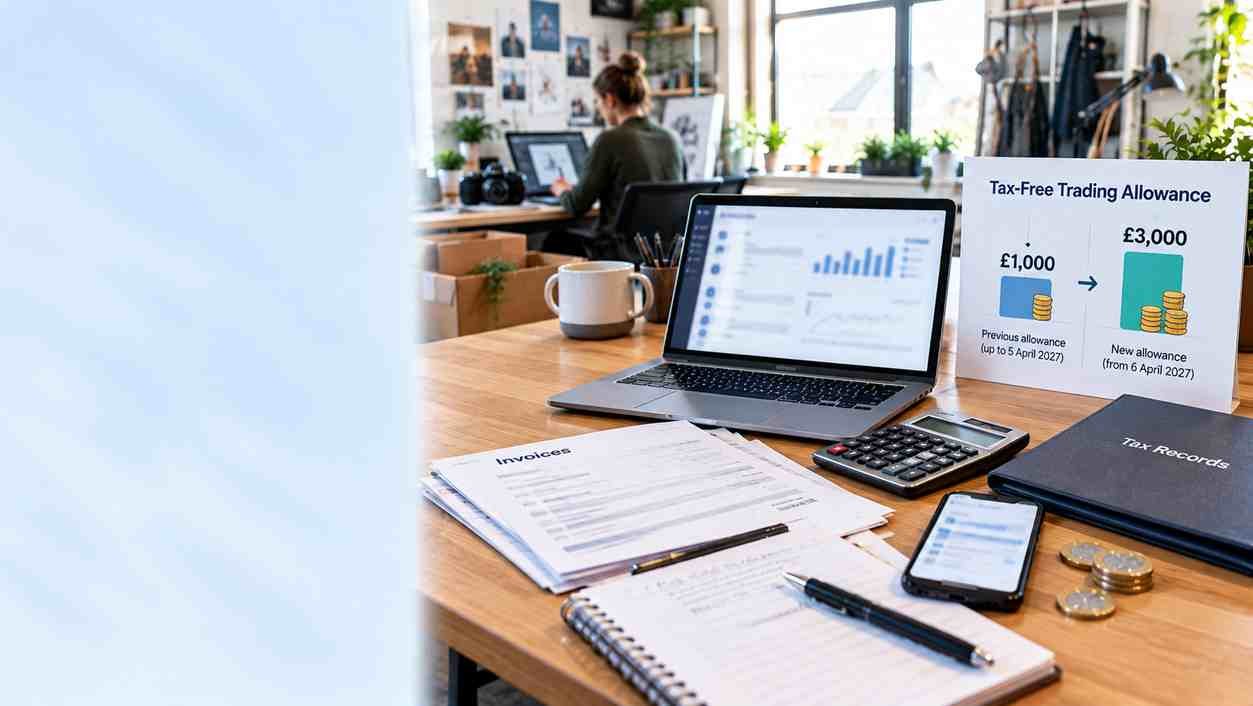
A new £3,000 tax-free allowance has been announced in the latest UK Budget, giving millions of people who earn money from small trading activities or side hustles a potentially simpler way to earn income without paying Income Tax on the first £3,000.
The measure was announced by Chancellor John Healey in Budget 2026 and will increase the existing Trading Allowance from £1,000 to £3,000.
The new limit is due to take effect from 6 April 2027.
However, the change does not mean every UK taxpayer will suddenly receive an extra £3,000 tax-free on top of their normal Personal Allowance.
Instead, it is specifically aimed at people receiving trading and miscellaneous income, including those making money through certain small businesses and side activities.
What is the new £3,000 allowance?
The Trading Allowance is a tax allowance for individuals who earn money from trading or certain miscellaneous activities.
Under the current rules, the allowance is £1,000.
Budget 2026 announced that this will be tripled to £3,000 from 6 April 2027.
The Government says the measure is designed to support people taking their first steps towards starting a small business.
In practical terms, an individual with qualifying trading or miscellaneous income of up to £3,000 a year may be able to receive that income without paying Income Tax on it under the Trading Allowance.
This is separate from the normal Personal Allowance.
Who could benefit from the £3,000 allowance?
The change could be particularly relevant to people earning smaller amounts outside their main employment.
Examples could include people who:
- Sell goods or services as a side business
- Make occasional income from trading activities
- Run a small online business
- Earn money from certain casual or miscellaneous trading activities
- Are starting a small business alongside employment
- Have a small self-employed income stream
The exact tax treatment depends on the nature of the activity and the individual’s circumstances.
The Budget document specifically describes the new allowance as covering trading and miscellaneous income.
It is not a second Personal Allowance
This is one of the most important points for taxpayers.
The £3,000 figure should not be confused with the standard Personal Allowance.
The Personal Allowance is the amount of income most people can receive before Income Tax becomes payable, subject to the normal rules.
The new £3,000 measure is instead the Trading Allowance.
So someone earning £2,500 from qualifying trading activity does not simply get £2,500 added to their existing Personal Allowance.
The £3,000 allowance relates specifically to qualifying trading and miscellaneous income.
When will the new rule start?
The increased allowance is scheduled to begin on 6 April 2027.
Until then, the existing £1,000 Trading Allowance remains the relevant limit.
The Budget 2026 policy document confirms that legislation will be introduced through Finance Bill 2026-27 and that the change will take effect from 6 April 2027.
This means taxpayers should not automatically apply the £3,000 figure to income earned during the current tax year.
The tax year in which the income is received matters.
How does the current £1,000 allowance work?
The existing Trading Allowance allows an individual to earn up to £1,000 of gross trading income without needing to calculate tax on the profit in the usual way.
For people whose trading income is above the allowance, there are different ways of working out taxable profits.
One option can be to use the £1,000 allowance instead of deducting actual allowable expenses.
The other option is to calculate actual allowable expenses and pay tax on the resulting profit.
The most suitable method can depend on the individual’s circumstances.
What will change after April 2027?
The biggest change is simply the size of the allowance.
| Tax year | Trading Allowance |
|---|---|
| Current rules | £1,000 |
| From 6 April 2027 | £3,000 |
That represents an increase of £2,000 in the amount covered by the Trading Allowance.
The Government describes this as tripling the generosity of the allowance.
For someone whose qualifying trading income is £3,000 or less, the change could significantly simplify their tax position.
Is the £3,000 completely tax-free?
There is an important distinction here.
The Government says the increased Trading Allowance will allow individuals to receive up to £3,000 of trading and miscellaneous income tax-free each year.
But this does not mean every type of income is covered.
Salary from employment, State Pension income, most pension income and other forms of taxable income are not suddenly covered by this £3,000 allowance.
It applies to the qualifying trading and miscellaneous income covered by the Trading Allowance rules.
What about people with a full-time job?
You can potentially benefit from the Trading Allowance even if you already have a job.
For example, someone could have a full-time employment income and also run a small side business.
Their salary continues to be taxed under the normal Income Tax rules.
The qualifying income from their separate trading activity can potentially benefit from the Trading Allowance.
However, the person’s overall tax position can still depend on other income and circumstances.
The £3,000 allowance should therefore not be interpreted as £3,000 that every employee can simply subtract from their salary before paying tax.
Could this help online sellers?
Potentially, yes.
People who sell goods or services online and whose activities amount to trading may be among those who benefit from the higher allowance.
This could be relevant to people running small side businesses through online marketplaces or social-media platforms.
However, whether someone is actually carrying on a trade depends on their circumstances.
Simply selling unwanted personal possessions does not automatically mean someone is carrying on a taxable trading business.
The nature and purpose of the activity matter.
What about occasional side income?
The higher allowance could also make a difference for people who earn relatively small amounts from occasional activities that fall within the Trading Allowance rules.
For example, someone testing a small business idea could potentially receive up to £3,000 of qualifying trading or miscellaneous income under the new allowance.
That could make it easier for people to experiment with a small business without immediately facing the same administrative burden as someone running a larger enterprise.
The Government says the policy is specifically intended to help entrepreneurs take their first steps in starting a small business.
Does everyone earning £3,000 need to register for Self Assessment?
The answer depends on the individual’s circumstances and the amount and type of trading income.
The higher allowance is intended to simplify the tax position of people with smaller amounts of trading income.
However, taxpayers should not assume that the £3,000 figure means there are no reporting obligations in every situation.
HMRC rules around Self Assessment, trading income and record keeping can still apply depending on the circumstances.
Anyone whose income or circumstances fall outside the simple allowance should check the relevant HMRC guidance.
What if trading income is above £3,000?
The new allowance does not mean a person with £3,001 of trading income automatically pays Income Tax on the entire amount.
The tax rules allow people to consider how the Trading Allowance applies and how taxable profits are calculated.
For someone with trading income above the allowance, it may be necessary to calculate taxable profits and consider allowable expenses or use the Trading Allowance where appropriate.
The best approach can depend on the person’s actual costs and income.
For this reason, taxpayers should keep records of their trading income and relevant expenses.
What does the Budget mean for side hustlers?
The Budget measure is particularly relevant to the growing number of people earning additional income outside traditional employment.
Someone might start a small online business, provide freelance services or sell products alongside their main job.
The £3,000 allowance gives these individuals more room before the Trading Allowance limit is reached.
The Government estimates that the measure will cost the Exchequer money because more trading income will fall within the tax-free allowance. The Budget policy table puts the expected tax impact at £225 million in 2027-28, rising over subsequent years.
Is this the same as the £3,000 Capital Gains Tax allowance?
No.
There is another completely separate £3,000 tax figure in the UK tax system.
The Capital Gains Tax Annual Exempt Amount is also £3,000 for individuals.
That allowance applies to certain capital gains rather than trading income.
HMRC confirms that individuals generally have a £3,000 annual exempt amount for Capital Gains Tax.
The Budget announcement discussed here is different.
It is the increase in the Trading Allowance from £1,000 to £3,000.
This distinction is important because the two £3,000 figures apply to different types of income and gains.
Could pensioners benefit?
Some pensioners could potentially benefit if they also have qualifying trading or miscellaneous income.
For example, a pensioner who receives their State Pension and runs a small side business could potentially use the Trading Allowance against qualifying trading income.
But the £3,000 allowance does not make the State Pension itself tax-free.
State Pension income remains subject to the normal Income Tax rules where applicable.
Therefore, pensioners should not read the Budget announcement as a new £3,000 tax-free pension allowance.
Could Universal Credit claimants use it?
The tax allowance itself is separate from the Universal Credit system.
Someone receiving Universal Credit who also earns money from self-employment may have both tax and benefit rules to consider.
The Trading Allowance deals with Income Tax.
Universal Credit has its own rules for how earnings affect entitlement.
Therefore, someone should not assume that £3,000 of trading income will automatically be ignored when Universal Credit is calculated.
The tax position and benefit position are separate questions.
What should small traders do now?
There is no need to change your tax arrangements immediately simply because the Budget has announced the future increase.
The new £3,000 limit is scheduled for 6 April 2027.
Until then, the existing £1,000 Trading Allowance remains relevant.
People running a small business or side hustle should continue keeping records of:
- Trading income
- Business expenses
- Invoices and receipts
- Online marketplace sales
- Other relevant business transactions
Good records can make it easier to work out the correct tax position when required.
Will the change remove all tax paperwork?
Not necessarily.
The higher allowance should reduce the tax burden for some people with smaller trading activities, but it does not abolish HMRC’s wider tax rules.
A taxpayer may still have reporting responsibilities depending on their income, business structure and other circumstances.
The Government’s stated aim is to make it easier for people to take their first steps into small business rather than remove the entire tax system surrounding self-employment.
What else did Budget 2026 announce?
The £3,000 Trading Allowance is only one of several measures affecting individuals and businesses.
The Budget also confirmed that the cash ISA limit will remain at £20,000 from 6 April 2027, reversing the previously planned reduction for many savers.
There are also measures affecting savings income, businesses, pensions, capital gains and other areas of taxation.
This means taxpayers should look at the specific measure relevant to their circumstances rather than assuming every Budget announcement applies to them.
The key date taxpayers should remember
For anyone interested in the new allowance, the most important date is:
6 April 2027.
That is when the Trading Allowance is scheduled to rise from £1,000 to £3,000.
The change will be introduced through Finance Bill 2026-27.
Until that date, taxpayers should continue to use the existing rules.
Final message for UK taxpayers
The Budget 2026 announcement of a £3,000 Trading Allowance could provide a useful tax break for people earning smaller amounts from trading and miscellaneous activities.
But it is important to understand exactly what has been announced.
This is not a new £3,000 Personal Allowance for everyone.
It is an increase in the Trading Allowance from £1,000 to £3,000, allowing qualifying individuals to receive up to £3,000 of trading and miscellaneous income tax-free each year under the new rules.
The change is scheduled to begin on 6 April 2027.
For employees, pensioners and other taxpayers without qualifying trading income, the announcement does not create a general £3,000 tax-free payment or allowance.
For people running small side businesses, however, the increase could make a noticeable difference and may make it easier to earn additional income without immediately moving into the more complex tax arrangements that can apply to larger trading activities.