





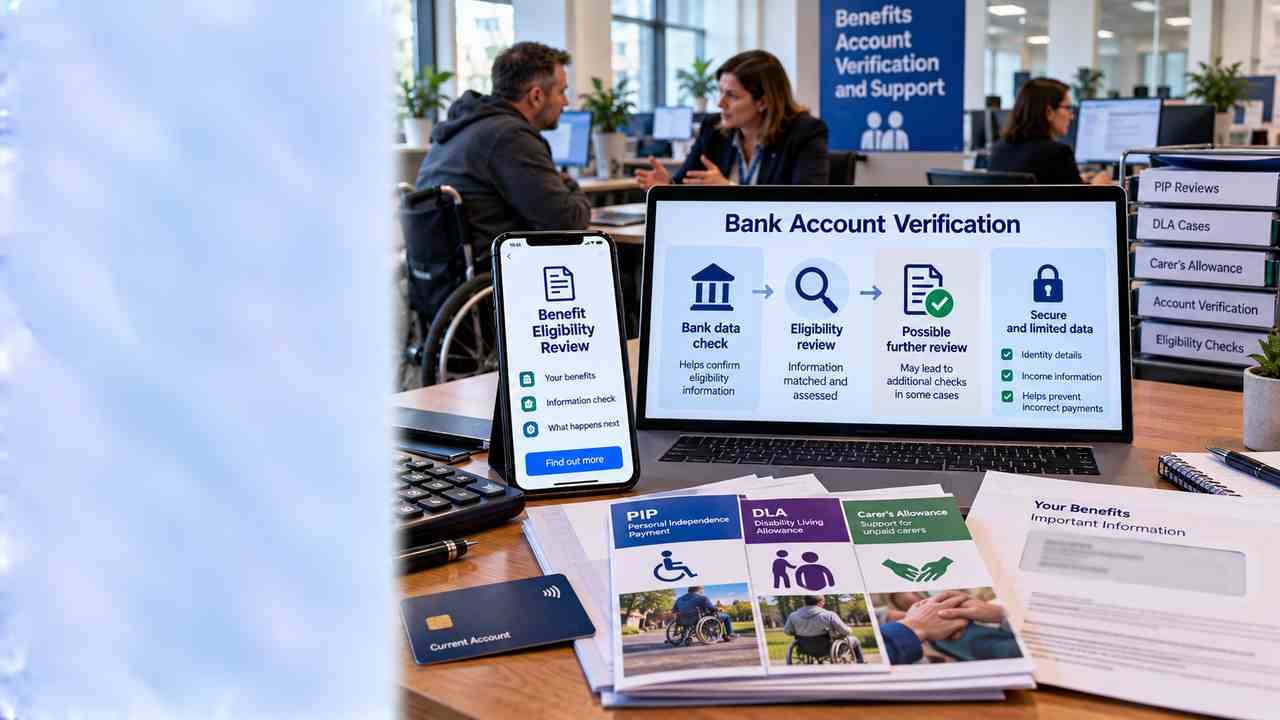
People receiving Personal Independence Payment (PIP), Disability Living Allowance (DLA) and Carer’s Allowance may be concerned about new Department for Work and Pensions (DWP) powers involving bank account information.
The changes are part of a wider government effort to identify incorrect benefit payments and check whether claimants continue to meet the rules for financial support.
The DWP published updated guidance on 13 October 2026 explaining how its Eligibility Verification Measure works. Under this measure, banks and other financial institutions must provide limited information when they receive a valid Eligibility Verification Notice. The information can help the department identify cases where a benefit may have been paid incorrectly.
However, there is an important distinction for people receiving disability benefits and carer support.
The new Eligibility Verification Measure currently covers Universal Credit, Pension Credit and New Style Employment and Support Allowance (ESA). PIP, DLA and Carer’s Allowance are not currently listed as benefits directly covered by this measure.
This does not mean DWP can never ask someone receiving PIP, DLA or Carer’s Allowance for information during an existing benefit review. Separate review and investigation processes already exist.
Here is what the new bank-checking rules mean, which benefits are covered and what claimants should know.
What Are the New DWP Bank Account Checks?
The Eligibility Verification Measure, or EVM, allows the DWP to require banks and other financial institutions to check their own records against specified indicators linked to benefit eligibility.
The purpose is to help identify cases where someone may not be receiving the correct amount of benefit.
For example, certain benefits have rules about savings, capital, income or time spent outside the UK. Information held by financial institutions may help identify accounts that need further examination.
The bank does not decide whether a claimant has broken the rules. It checks the relevant information and shares the limited details required by the notice.
The DWP can then decide whether further enquiries are necessary.
The measure is intended to help identify incorrect payments earlier and reduce the risk of overpayments building up. It may also help ensure that people who qualify for support receive the correct amount.
The checks should not be interpreted as meaning that every benefit claimant is suspected of wrongdoing.
An account being flagged for further examination does not, by itself, prove fraud or establish that a benefit has been paid incorrectly.
Which Benefits Are Covered by the New Measure?
The official DWP guidance currently identifies three benefits covered by the Eligibility Verification Measure:
- Universal Credit.
- Pension Credit.
- New Style Employment and Support Allowance.
These benefits have eligibility conditions that can make information about savings, accounts or time spent abroad relevant to checking entitlement.
The government’s published code of practice confirms that these are the benefits currently in scope. It also explains that other benefits could be added in the future, but any expansion would require regulations to be approved by both Houses of Parliament.
This is an important point for people receiving other forms of support.
Although the government has introduced wider powers to check benefit eligibility, the new bank-data measure is not a blanket power covering every DWP benefit.
The rules currently apply to the benefits specifically identified in the official guidance.
Are PIP Claimants Included?
Personal Independence Payment is a disability benefit for eligible people whose long-term health conditions or disabilities affect daily living or mobility.
PIP is not means-tested. A person’s savings and income do not ordinarily determine whether they qualify for the benefit.
Under the new Eligibility Verification Measure, PIP is not one of the three benefits currently listed as being directly covered by the bank-data checks.
However, this does not mean PIP claims can never be reviewed.
The DWP already has processes for checking whether benefit payments are correct. A claimant selected for an existing review may be asked questions or requested to provide supporting documents.
The government’s guidance on benefit-payment review appointments explains that people receiving PIP can be selected for a review and may be asked to provide documents relating to their circumstances. The guidance says the claimant will receive a letter in advance explaining the appointment.
These existing reviews are different from the new Eligibility Verification Measure.
People receiving PIP should therefore avoid assuming that the new bank-checking rules automatically apply to their benefit.
They should continue to provide accurate information when required and respond to genuine DWP correspondence.
What About Disability Living Allowance?
Disability Living Allowance, or DLA, provides support for eligible disabled people. It is primarily associated with children and certain existing claimants, as most eligible working-age adults make new claims for PIP instead.
DLA is not currently listed among the benefits directly covered by the new Eligibility Verification Measure. The current list names Universal Credit, Pension Credit and New Style ESA.
Nevertheless, DLA claimants should understand that separate benefit reviews and eligibility checks can still take place under the applicable rules.
If the DWP contacts a claimant about their award, they should read the letter carefully to establish what information is being requested and why.
A routine review does not automatically mean the claimant has done anything wrong.
Anyone who is unsure about a request should check it using official government contact details before sharing personal information.
Could Carer’s Allowance Claimants Face Checks?
Carer’s Allowance is financial support for eligible people who provide regular care for someone who receives a qualifying disability benefit.
It has specific eligibility rules, including requirements relating to the care provided and the claimant’s earnings.
Carer’s Allowance is not currently included in the three-benefit list for the new Eligibility Verification Measure.
However, the DWP already carries out reviews of Carer’s Allowance claims.
The government’s existing guidance on benefit-payment review appointments specifically includes Carer’s Allowance. A selected claimant may receive advance notice of a telephone appointment and may be asked to provide documents supporting their circumstances.
This distinction matters because Carer’s Allowance has its own eligibility rules.
For example, changes in earnings or caring circumstances may affect whether someone continues to qualify.
Claimants should report relevant changes as required and keep records that help explain their circumstances.
The existence of an existing review process should not be confused with automatic inclusion in the new bank-data measure.
What Information Can Banks Share With the DWP?
The Eligibility Verification Measure places limits on the information that financial institutions can provide.
Where an account meets the relevant eligibility indicators, banks may share specified details such as:
- The names of account holders.
- Details of relevant accounts, including linked or joint accounts.
- Account numbers and sort codes, where applicable.
- Information about the amount of money held in relevant accounts.
- Dates of transactions that took place in another country, where requested under the measure.
The precise information depends on the notice and the indicators being checked.
The official guidance also states that banks cannot share full bank statements or complete transaction histories through this measure. They cannot provide details about how a claimant spends their money, sensitive personal information such as political or religious beliefs, or specific transaction locations.
These restrictions are important.
The measure is designed to provide limited information relevant to benefit eligibility, rather than give the DWP unrestricted access to someone’s banking activity.
The department also cannot use this measure to log into a claimant’s online banking or watch their account in real time.
Will the DWP Be Able to See Every Bank Account?
The measure is not an unrestricted search of every person’s finances.
The official code of practice explains that the DWP can issue notices relating to accounts receiving payments of benefits covered by the measure. Linked accounts can also be considered where they meet the relevant eligibility indicators.
Banks carry out the checks using information they already hold and the criteria specified in the notice.
This means the measure can identify certain accounts that may require further examination, but it does not automatically give the DWP access to every transaction or every detail of a person’s financial life.
There are also restrictions on the data that may be requested and shared.
The department must use the information for the purposes allowed under the measure and comply with relevant data-protection requirements.
Could a Bank Check Lead to Benefit Payments Being Stopped?
Not automatically.
A bank-data match is an indicator that further examination may be necessary. It is not a final decision that a claimant is ineligible or has committed fraud.
If information suggests that a benefit may have been paid incorrectly, the DWP may review the claim and contact the person for further information.
The department’s guidance says that claimants may be asked questions or asked to provide documents to support their eligibility. Any decision affecting benefit entitlement or payments is made by DWP staff.
The outcome depends on the circumstances.
The DWP may establish that the claimant remains entitled to the benefit. Alternatively, it may identify an error that requires the award to be corrected.
If a claimant disagrees with a benefit decision, the official guidance explains that they can ask for it to be looked at again through a process known as mandatory reconsideration.
Claimants should therefore respond promptly to genuine requests for information rather than assuming that a review means their payments will automatically stop.
What Should Benefit Claimants Do Now?
People receiving PIP, DLA, Carer’s Allowance or other benefits can take a few practical steps to protect their claims.
1. Keep your information accurate
Tell the relevant department about changes that could affect your entitlement, following the rules for your particular benefit.
2. Read official letters carefully
If the DWP asks for information, check what it needs, the reason for the request and any deadline.
3. Keep relevant documents
Depending on your benefit, useful records may include award letters, earnings information, caring records or documents explaining changes in your circumstances.
4. Verify unexpected contact
If someone contacts you claiming to be from the DWP, check the request using official government contact details before sharing sensitive information.
5. Ask for clarification if necessary
If you do not understand a request or believe a decision is incorrect, seek clarification and consider independent welfare-rights advice.
These steps are sensible for benefit claimants generally. They do not mean that everyone receiving disability or carer support is subject to the new bank-data measure.
Could the List of Covered Benefits Change?
Yes, potentially.
The official code of practice says other benefits could be added to the Eligibility Verification Measure through future regulations, subject to approval by both Houses of Parliament.
However, the possibility of a future expansion is not the same as confirmation that PIP, DLA or Carer’s Allowance will be added.
Any such change would need to be established through official announcements and the relevant legislative process.
Claimants should therefore rely on the current list rather than assume that every benefit will automatically become subject to the same checks.
What This Means for PIP, DLA and Carer’s Allowance
The DWP’s updated guidance confirms that banks and other financial institutions can be required to share limited information under the Eligibility Verification Measure to help identify potentially incorrect benefit payments.
But the current measure directly covers Universal Credit, Pension Credit and New Style ESA—not PIP, DLA or Carer’s Allowance.
Those three benefits can still be subject to their own existing review and eligibility processes, so claimants should continue to keep their information accurate and respond to genuine requests from the department.
The most important distinction is between a new bank-data verification power and the DWP’s existing ability to review individual benefit claims.
A bank-data match does not automatically mean that someone has committed fraud, will lose their benefit or will have their payments stopped.
For the latest rules, claimants should check the official DWP Eligibility Verification Measure guidance and follow any instructions sent directly to them.