





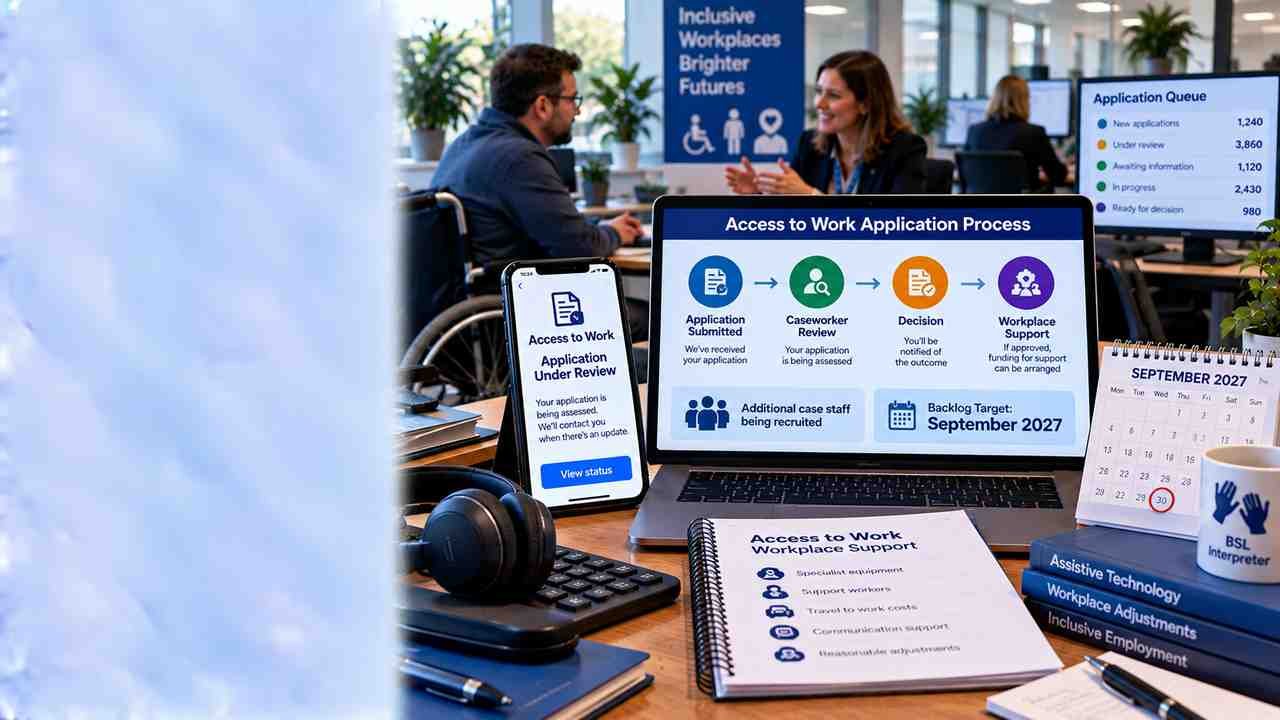
Disabled people and those with long-term health conditions who need help to start or remain in employment could be affected by changes planned for the Department for Work and Pensions’ Access to Work service.
The Government has announced a recruitment drive aimed at tackling the scheme’s application backlog by September 2027. The plan involves recruiting 480 additional case managers and caseworkers to help process applications and improve the service for people who rely on workplace support.
However, the September 2027 date does not represent a confirmed deadline for new eligibility rules. The immediate priority is to increase staffing and reduce waiting times, while the Government continues to consider wider reforms to the scheme.
For people who are preparing to apply, already waiting for a decision or approaching a grant renewal, understanding what has actually been announced is important.
What Is the DWP Access to Work Change?
The Department for Work and Pensions announced its latest recruitment plan on 19 May 2026. It aims to address the backlog of Access to Work applications by September 2027.
The Government plans to recruit 480 additional case managers and caseworkers. According to the DWP, this would increase the number of people working on the scheme by around 72% compared with the 658 staff previously working on it.
The recruitment drive follows a substantial increase in demand for the service. The DWP reported that the number of claims had more than doubled since 2018/19, contributing to pressure on the system and delays for applicants.
At the time of the announcement, around 60,000 applicants were awaiting a decision, according to the Government.
The aim is to give the service greater capacity to process applications and help disabled people obtain the practical support they need to work.
Official position: The September 2027 target relates to clearing the application backlog. The Government has also been considering wider reforms, but the recruitment announcement itself does not introduce a new set of eligibility rules.
Who Could Be Affected by the Changes?
The planned improvements could matter to several groups of people who use or are considering applying for Access to Work.
These include:
- Disabled people preparing to start a new job.
- Employees who need workplace equipment or specialist software.
- People who require a support worker or communication assistance.
- Workers who need help with additional travel costs.
- People with mental health conditions who need support to remain in employment.
- Self-employed people who need practical assistance to carry out their work.
- Existing recipients approaching a grant renewal or review.
The effect will depend on each person’s circumstances and the progress made in reducing waiting times.
People who are waiting for an application decision may benefit if the additional staffing helps the DWP process cases more quickly. However, the Government has not guaranteed that every applicant will receive a decision by September 2027.
The recruitment target should therefore not be treated as a promise that all individual applications will be completed by that date.
What Is Access to Work?
Access to Work is a publicly funded employment support programme for eligible disabled people and people with physical or mental health conditions.
It is designed to help people overcome barriers that might otherwise make it difficult to start a job, continue working or move into self-employment.
Depending on individual needs, the scheme can provide grants or other practical support for workplace-related costs.
Examples include:
- Specialist equipment and assistive technology.
- Adaptations to equipment used at work.
- Support workers, job coaches and note-takers.
- British Sign Language interpreters and other communication support.
- Additional travel costs where public transport cannot be used.
- Adaptations to a vehicle needed to travel to work.
- Support to manage a mental health condition in the workplace.
The scheme can also help people who work from home, where the requested assistance meets the programme’s requirements.
The support is based on an individual’s work-related needs rather than simply the name of their disability or health condition.
For example, one employee may need specialist computer software, while another may need a communication support worker or assistance with travel.
There is no single standard grant amount for every applicant. The support offered depends on the person’s circumstances and the help required to carry out their job.
The grant does not normally have to be repaid and does not affect other benefits, according to the official guidance.
Will New Eligibility Rules Start in September 2027?
There is an important distinction between the announced recruitment programme and possible future changes to Access to Work.
The DWP has confirmed its intention to recruit additional staff and reduce the backlog by September 2027. It has also acknowledged that wider changes to the scheme are being considered.
However, the September 2027 announcement does not, by itself, establish a new eligibility test or confirm that existing recipients will automatically lose support.
The Government has said it is considering evidence from disabled people, employers and representative organisations to help shape potential reforms.
A written parliamentary answer in June 2026 also stated that any improvements to Access to Work would be announced before implementation.
Applicants should therefore avoid assuming that the recruitment deadline means a new application process, a universal funding reduction or a change to every existing award.
If the Government announces specific reforms later, the details will need to be assessed separately.
What Does This Mean for New Applicants?
People who believe they need Access to Work support do not need to wait until September 2027 simply because the backlog target falls in that month.
Eligible people can apply under the existing arrangements.
The official guidance says applicants generally need to be aged 16 or over, normally resident in and working in Great Britain, and have a disability or health condition that creates a need for workplace support.
They must also be in paid work, about to start work or become self-employed, or meet another qualifying work-related circumstance covered by the scheme.
Support may also be available for communication assistance at a job interview.
Eligibility depends on the full circumstances of the application, so meeting one of these conditions does not guarantee an award.
People considering applying should explain the practical difficulties they experience at work and the specific assistance they believe would help.
For example, an applicant might need assistive software to complete work tasks, a support worker to carry out certain duties or help with additional travel costs because their condition prevents them from using available public transport.
Providing clear information about the job, the barriers faced and the requested support can help the DWP assess the application.
Could Waiting Times Improve Before September 2027?
That is one of the main aims of the recruitment drive, although the results will depend on how quickly additional staff are recruited, trained and able to process cases.
The DWP said in May 2026 that payment delays had already been eliminated and that 96% of urgent cases involving applicants due to start work within four weeks had been cleared within 28 days.
The Government also said it was prioritising applications from people who were due to start work within four weeks.
These figures describe the position reported at the time of the announcement. They should not be interpreted as a guarantee that every urgent case, renewal or standard application will be completed within 28 days.
Applicants may still need to wait for decisions, particularly where their circumstances or support requirements are complex.
The additional caseworkers are intended to improve the service’s capacity, but the precise waiting time for an individual case can vary.
If a job start date is approaching, applicants should make this clear when contacting the Access to Work team.
What Support Can Existing Access to Work Recipients Expect?
People who already receive Access to Work support should not assume that the September 2027 target automatically changes their award.
Awards are based on individual work-related needs and the support agreed with the DWP. The relevant award letter sets out the assistance approved and the period covered.
A person’s needs may change if they move to another job, change employers, work different hours or require different equipment.
Existing recipients should check the terms of their award and contact the Access to Work team if their circumstances change.
If a grant is approaching its renewal date, it is sensible to check the renewal arrangements early rather than assume that the recruitment drive will automatically extend the existing award.
The DWP has also acknowledged concerns about the timeliness and consistency of decisions. It is continuing to consider ways to improve how the service operates.
Any future changes to award reviews, funding or eligibility should be checked against the official guidance in force at the time.
Could Access to Work Funding Be Reduced?
Some recipients and disability organisations have raised concerns about reductions in individual support packages.
The House of Commons Library’s briefing on Access to Work has discussed reports of funding reductions and concerns about how consistently the scheme’s guidance is applied.
The Government has said it has not made a general policy change to Access to Work, while the DWP has acknowledged that some recipients may have experienced lower funding where its existing guidance has been applied more rigorously and consistently.
This distinction matters because a change to an individual award does not necessarily mean that a new nationwide funding cut has been introduced.
Access to Work awards are assessed according to individual circumstances and work-related needs. The amount approved may therefore differ between people, even where their health conditions appear similar.
Anyone who believes their award does not adequately reflect their needs should read the decision carefully and contact the DWP to ask about the available reconsideration process.
The official factsheet explains that recipients can request one reconsideration of an award by a different Access to Work case manager.
Where a person’s job or circumstances have changed, they may also ask for their award to be reviewed.
How to Apply for Access to Work
People who need support can use the official GOV.UK service to check eligibility and apply.
Before starting, it may help to gather information about the job, workplace and support required.
Depending on the circumstances, applicants may need details such as:
- Their National Insurance number.
- Their workplace address.
- A workplace contact’s details.
- Information about the job and the barriers caused by their condition.
- A job offer or start date, where applicable.
- Business information if they are self-employed.
The DWP may contact an employer for additional information as part of the process.
Applicants should describe the support they need as clearly as possible. They should also keep copies of relevant documents and any correspondence about their application.
If someone is already waiting for a decision, they can contact the Access to Work team to explain any urgent work-related deadline or change in circumstances.
The official application service and guidance are available on GOV.UK.
What If an Access to Work Application Is Delayed?
Waiting for workplace support can create practical difficulties, especially when a person needs specialist equipment or communication assistance to begin a job.
If an application is delayed, the applicant should contact the Access to Work team and explain the situation.
It may be particularly important to highlight an upcoming job start date, a change in employment or a support requirement that is preventing the person from carrying out their duties.
Applicants should keep records of contact with the DWP and check any letters or emails carefully.
If the applicant disagrees with a decision, the official guidance explains how to request reconsideration. Complaints about the service can also be raised through the relevant procedure.
An employer may have separate legal responsibilities to make reasonable adjustments for a disabled employee. Access to Work does not normally pay for adjustments that the employer is legally required to make.
People should therefore consider both the support available through Access to Work and the responsibilities of their employer.
Where Does Access to Work Apply?
The Access to Work programme described in the DWP guidance applies to England, Scotland and Wales.
Northern Ireland has a separate service, so people living there should check the relevant Northern Ireland arrangements instead.
The Channel Islands and the Isle of Man are not covered by the Great Britain scheme.
Applicants should confirm which service applies to their location before relying on guidance intended for Great Britain.
What Should Applicants Watch for Next?
The main development to watch is whether the DWP’s recruitment programme produces faster decisions and a meaningful reduction in the backlog.
The Government has also indicated that it is considering wider changes to make Access to Work fairer, more sustainable and more effective.
Further announcements could explain whether the application process, award reviews or other parts of the service will change.
Until those details are published, applicants should rely on the current official guidance rather than social media claims about new restrictions or guaranteed payments.
The September 2027 target is a significant milestone for the DWP’s backlog-reduction plan, but it should not be confused with a confirmed date for a complete overhaul of the scheme.
Final Word
The DWP’s Access to Work programme is intended to help eligible disabled people and people with health conditions start or remain in employment.
The Government plans to recruit 480 additional case managers and caseworkers, with the aim of clearing the application backlog by September 2027.
For new applicants, the key point is that they can apply under the existing rules rather than waiting for that deadline. Existing recipients should check their award letters, keep the DWP informed of changes and seek clarification if their support is due for renewal.
Wider reforms are still being considered, so any future eligibility or funding changes should be confirmed through official announcements before applicants make decisions about their support.
Official guidance: Check the latest Access to Work eligibility, application and review information on GOV.UK before applying or making changes to an existing award.