





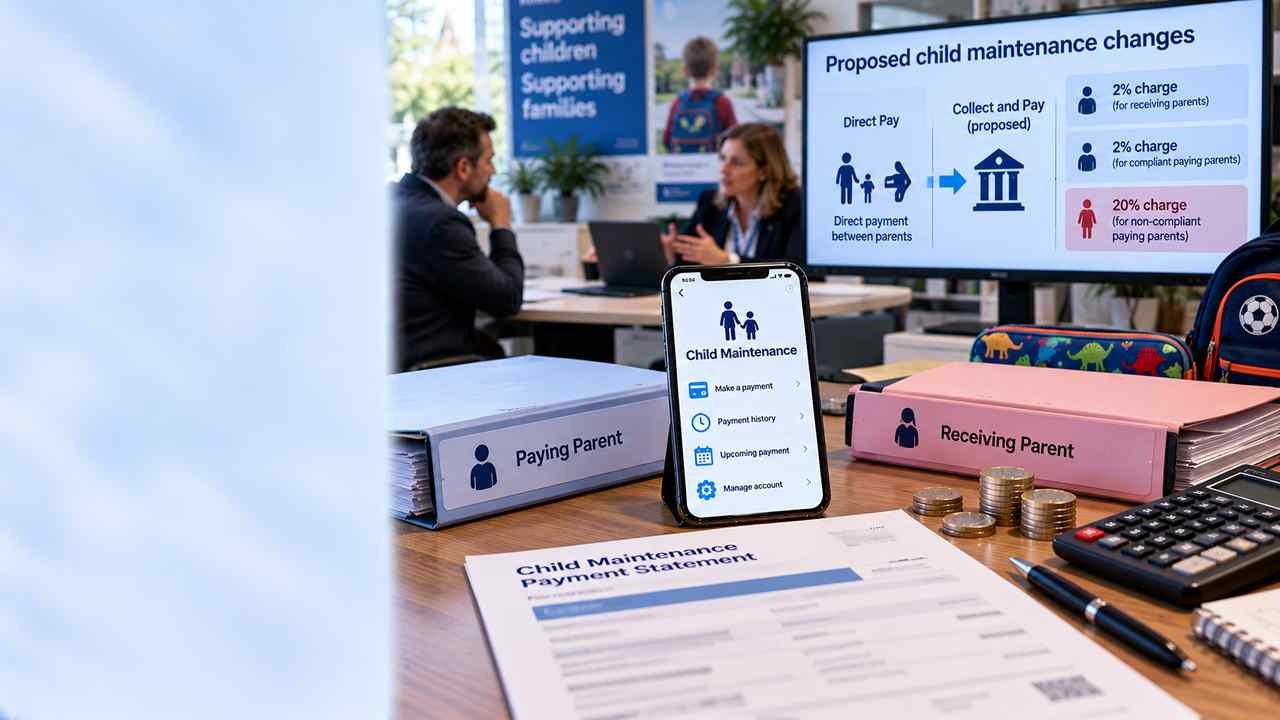
Parents using the UK’s Child Maintenance Service could face a major change to how payments are collected, with the Government planning to remove the existing Direct Pay option and introduce a new fee structure.
The proposed shake-up could mean some parents paying a smaller charge than they would under today’s Collect & Pay system, while parents who fail to keep up with payments could face a much higher 20% charge.
However, the changes are not yet in force. The Government says legislation will be needed before the reforms can be introduced, with implementation currently aimed for 2027 to 2028, subject to Parliamentary time and approval.
For separated parents who rely on the Child Maintenance Service (CMS), the changes could therefore make a significant difference to how payments are made, monitored and recovered.
What is changing with Child Maintenance?
The biggest proposed change is the removal of Direct Pay.
At present, parents using the CMS can have the amount of child maintenance calculated by the service but make payments directly between themselves through Direct Pay.
There are currently no collection fees when Direct Pay is used.
The alternative is Collect & Pay, where the CMS collects money from the paying parent and passes it to the receiving parent. This service currently comes with collection charges.
Under the Government’s planned reforms, Direct Pay would be removed and statutory CMS cases would move into a single system where the CMS can monitor payments directly.
The Government says this is intended to make it easier to identify missed or late payments and allow action to be taken more quickly where a parent does not comply.
New 2% charge could apply to parents
One of the biggest points in the proposed reform is the new 2% collection charge.
Under the planned structure, a receiving parent would have 2% deducted from the maintenance they receive.
A paying parent who remains compliant would have a 2% charge added to their child maintenance liability.
For example, if a parent’s calculated child maintenance liability was £200, a 2% fee would be £4.
That would mean the paying parent’s liability could become £204 under the proposed structure, while the receiving parent could receive £196 after a 2% deduction.
These figures are examples based on the proposed percentage and are not a new current payment rate.
The Government says the reduced charge is intended to contribute towards the cost of running the CMS while encouraging parents to keep payments up to date.
What happens if a parent does not pay?
The proposed system would have a much bigger financial consequence for parents who fail to comply.
A 20% fee is planned for paying parents who are classed as non-compliant.
This would be added to the child maintenance liability.
So, using a simple £200 liability as an example, a 20% fee would represent an additional £40.
The parent could therefore face a £240 liability before any separate arrears arrangements were taken into account.
The 20% figure is part of the Government’s proposed reformed fee structure. It is not a new charge that has already replaced the current system.
The Government has also said that parents who return to compliance could move back to the lower fee. Its published response envisages proactively moving paying parents off the 20% fee after six months of compliance.
There would also be scope for genuine reasons for missed payments to be considered by CMS caseworkers, such as banking or system errors or certain circumstances affecting the paying parent.
What are the current CMS charges?
Until any new legislation comes into force, the existing Collect & Pay system remains relevant.
Current GOV.UK guidance states that a paying parent using Collect & Pay is charged 20% on top of the child maintenance amount collected.
A receiving parent has 4% deducted from the amount due when the CMS passes the payment on.
Direct Pay does not have collection fees.
This means the proposed system would actually reduce the standard collection fee for compliant parents.
The key difference is that the proposed 2% structure would apply within the planned single CMS service rather than allowing parents to avoid collection charges by remaining on Direct Pay.
Why does the Government want to remove Direct Pay?
The Government says the change is partly about improving compliance and protecting families.
Under Direct Pay, parents agree between themselves how and when payments are transferred after the CMS calculates the amount.
If a payment is missed, the receiving parent currently has to report the issue before enforcement can begin through CMS.
The Government says this can create delays and conflict between separated parents.
Moving cases into a single monitored system would allow the CMS to see payment activity more directly and identify potential non-compliance sooner.
There is also a specific focus on victims and survivors of domestic abuse.
The Government has argued that requiring a receiving parent to communicate with an ex-partner about missed payments can create additional stress or risk in some circumstances.
A centralised collection system is intended to reduce some of that direct interaction.
Could the changes affect the amount parents receive?
For some families, yes.
The proposed 2% charge for receiving parents would mean that the amount actually transferred could be slightly lower than the underlying child maintenance liability.
For example, a £300 maintenance liability would result in a proposed 2% receiving-parent charge of £6.
The receiving parent would therefore receive £294 before considering any arrears or other factors.
At the same time, a compliant paying parent would face a proposed 2% addition.
On a £300 liability, that would be £6.
So the paying parent could be responsible for £306 under the proposed structure.
These examples are purely illustrative. Actual CMS calculations can be more complicated, particularly where arrears, income changes or other circumstances are involved.
A higher charge could apply after missed payments
The financial difference becomes much greater if a paying parent is considered non-compliant.
The Government’s planned structure would apply a 20% fee rather than the 2% compliant rate.
This is designed to create a financial incentive to keep payments up to date.
The Government has said it wants the CMS to intervene earlier when payments are missed and recover money owed more quickly.
However, it has also recognised concerns that financial problems themselves can sometimes lead to missed payments.
The Government’s response says affordability should be considered when dealing with arrears repayment arrangements, rather than assuming every missed payment is simply a refusal to pay.
Child maintenance calculations could also change
The shake-up is not limited to collection fees.
The Government is also looking at how child maintenance calculations are made.
In July 2026, the Government confirmed plans to reduce the income tolerance from 25% to 15%.
The aim would be to ensure that significant changes in a paying parent’s income are reflected in maintenance calculations sooner.
The Government also plans to include unearned income within the standard calculation.
Unearned income can include money such as rental income, dividends and interest from savings and investments.
At present, certain types of additional income can already be considered through a variation process. GOV.UK guidance explains that parents can ask the CMS to consider some additional income, including rental income and interest or dividends above specified thresholds.
The planned reform could therefore make the standard calculation more closely reflect a paying parent’s overall financial circumstances.
What about parents who already use Collect & Pay?
Parents already using Collect & Pay could see the fee structure change if and when the new system is introduced.
Currently, the paying parent faces a 20% collection fee and the receiving parent has 4% deducted.
Under the proposed system, a compliant paying parent would instead face a 2% fee and the receiving parent would face a 2% deduction.
That could mean lower collection charges for parents who consistently pay on time.
However, a paying parent who becomes non-compliant could face the proposed 20% charge.
The Government has said that the higher fee is intended to act as a deterrent against non-payment.
Could Direct Pay disappear completely?
The Government has confirmed its intention to remove Direct Pay from the statutory CMS.
The proposed replacement would be a single Collect & Pay-style service in which payments are monitored and transferred by the CMS.
However, this should not be confused with parents who make their own family-based arrangements.
The Government continues to support family-based arrangements for parents who can agree child maintenance privately and do not need the statutory CMS service.
Where parents can safely reach an agreement themselves, they may therefore continue to manage child maintenance outside the statutory system.
When could the new charges start?
This is one of the most important points for parents.
The new charges are not currently in force.
The Government’s published response says removing Direct Pay and changing the collection fee structure will require legislation and Parliamentary scrutiny.
Subject to Parliamentary approval and available Parliamentary time, the Government has aimed to implement the reforms in 2027 to 2028.
More recent Parliamentary answers have continued to describe the removal of Direct Pay and the move to a single enhanced Collect & Pay system as Government plans that require legislation.
The Government says it intends to implement them when Parliamentary time allows.
This means parents should not assume that the 2% charge starts immediately.
What happens if a parent refuses to pay?
The CMS already has a range of enforcement powers, and these are expected to remain an important part of the system.
Current enforcement measures can include deductions from earnings, deductions from benefits, deductions directly from bank or building society accounts and court action.
In more serious cases, the CMS can use measures such as enforcement agents, charging orders and restrictions involving driving licences or passports, with imprisonment also possible in certain circumstances.
The Government is also introducing Administrative Liability Orders, designed to streamline the process for recovering unpaid child maintenance and reduce reliance on the current court-based process.
The aim is to allow enforcement action to happen more quickly when parents fail to meet their responsibilities.
What should parents do now?
Parents currently using the CMS do not need to start paying a new 2% fee simply because the proposed reform has been announced.
The existing rules continue to apply unless and until the relevant legislation and implementation changes take effect.
Parents using Direct Pay should also not assume they need to switch immediately.
The Government’s plan is to remove Direct Pay as part of the wider reform, but the change requires legislation.
Anyone struggling to maintain payments should contact the CMS rather than simply allowing arrears to build up.
Likewise, receiving parents who are missing payments should keep records and use the CMS process available to them.
What the shake-up means for families
The planned Child Maintenance Service changes could represent one of the biggest changes to the way statutory child maintenance is collected.
The headline figures are clear: a proposed 2% charge for compliant parents, a 2% deduction for receiving parents, and a potential 20% charge for non-compliant paying parents.
But the timing is equally important.
These are planned reforms rather than rules that have already taken effect.
The Government wants to remove Direct Pay, bring cases into one monitored collection system, improve enforcement and make changes to the way income is reflected in maintenance calculations.
For parents, the practical message is to keep up with payments and stay alert to official CMS communications.
Until Parliament approves the necessary legislation and the reforms are implemented, the existing CMS rules and charges continue to apply.