




More UK pensioners could find themselves paying Income Tax on their retirement income as the State Pension continues to rise while the Personal Allowance remains frozen.
The issue is particularly relevant for pensioners who receive the State Pension alongside a private or workplace pension, savings interest or other taxable income.
At the same time, Prime Minister Andy Burnham has announced plans to change the way the State Pension Triple Lock works from April 2030.
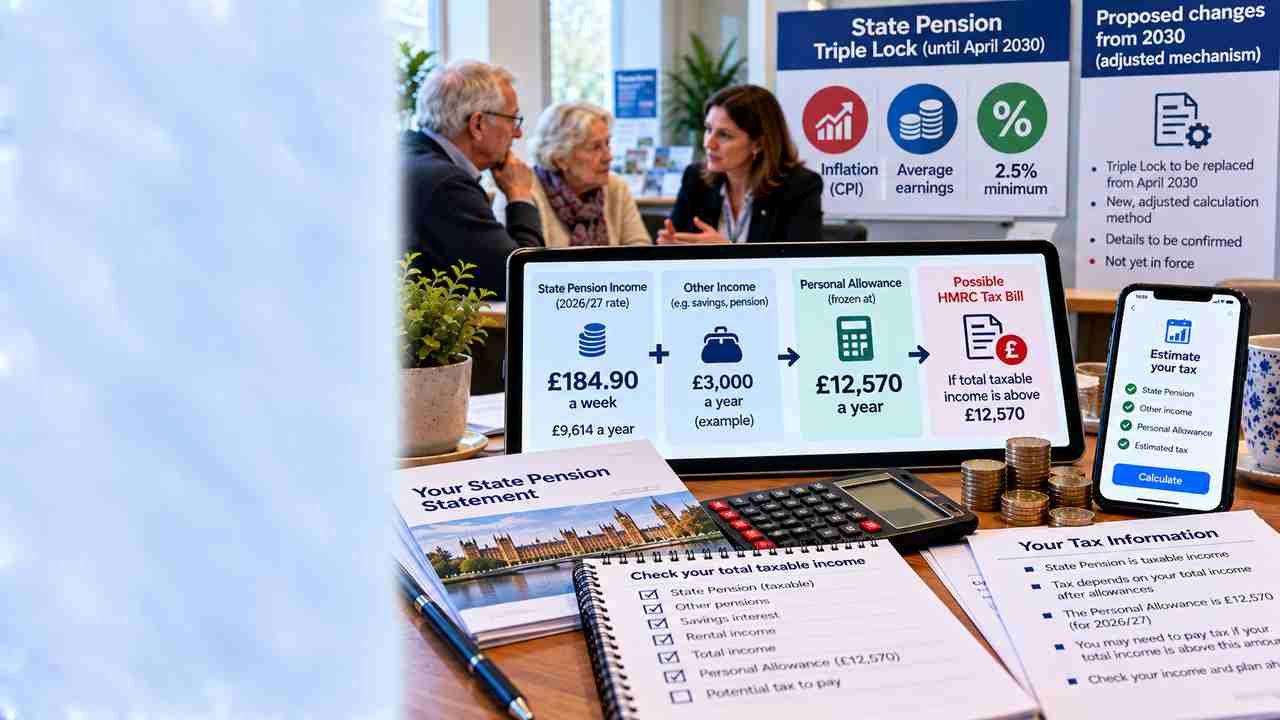
The current Triple Lock is due to remain in place until April 2030. After that, the government plans to adjust the system so the State Pension rises by at least inflation or 2.5%, while a new mechanism is intended to maintain its value relative to earnings over time.
For pensioners, however, the immediate issue is not the 2030 change.
The more immediate concern is the interaction between rising pension income and frozen tax thresholds.
Why More Pensioners Could Pay HMRC
The Personal Allowance is the amount of income a person can generally receive before Income Tax becomes payable.
For 2026/27, the standard Personal Allowance is £12,570.
The government has legislated for this allowance to remain at £12,570 through the 2030/31 tax year.
This creates an important situation for pensioners.
If the State Pension and other taxable income rise over time while the tax-free allowance remains unchanged, more people can potentially move above the tax-free threshold.
This does not mean that every pensioner will receive an HMRC bill.
It means that pensioners whose total taxable income exceeds their available Personal Allowance may have Income Tax to pay.
The State Pension Is Taxable Income
One of the most important points for pensioners is that the State Pension counts as taxable income.
However, tax is not normally deducted directly from the State Pension payment itself.
Instead, HMRC looks at a person’s overall taxable income and works out how much tax is due.
That can include the State Pension, private pensions, workplace pensions, employment income and certain other taxable income. GOV.UK provides a pension tax calculator based on these different income sources.
This means a pensioner with only a relatively modest State Pension may not pay Income Tax, while someone with the same State Pension plus a private pension could become liable.
The £12,570 Threshold Is Important
The standard Personal Allowance is currently £12,570.
For most people, income up to this level is not subject to Income Tax.
The government has now confirmed that the Personal Allowance will remain at this level until April 2031.
The freeze is significant because the value of the allowance does not rise in line with inflation.
If pension income increases while the allowance remains unchanged, the taxable portion of income can gradually become larger.
This is one reason why pensioners should look at their total income rather than focusing only on the weekly State Pension figure.
Who Could Be Most Affected?
The pensioners most likely to notice the effect are those with more than one source of taxable income.
For example, someone could receive:
- State Pension
- a workplace pension
- a private pension
- savings interest
- taxable investment income
- earnings from part-time work
The combined income can take the person above the Personal Allowance.
Someone receiving only the State Pension may have a very different tax position from another pensioner who receives the same State Pension plus a sizeable private pension.
A Simple Example
Consider a pensioner whose total taxable income is £15,000 in a tax year.
If the person has the standard £12,570 Personal Allowance, the amount above the allowance is £2,430.
At the basic 20% rate, that would represent £486 of Income Tax before considering any other allowances, deductions or circumstances.
This is only a simplified illustration.
Actual tax calculations can be different depending on the person’s income sources, tax code and other circumstances.
The important point is that the State Pension is part of the overall income calculation.
Why the Triple Lock Matters
The State Pension Triple Lock currently means the State Pension rises each year by whichever is highest of:
- inflation
- average earnings growth
- 2.5%
This mechanism has been used to increase the State Pension over successive years.
Andy Burnham has said the current system will remain unchanged until April 2030. From then, his government plans to modify the mechanism.
Under the proposed adjusted system, the State Pension would continue to rise each year by at least inflation or 2.5%, while a new earnings-related mechanism would be used to ensure pensioners retain a long-term share of rising national prosperity.
What Is Changing From 2030?
The planned change is not an immediate State Pension cut.
The government says the current Triple Lock will remain until April 2030.
From 2030, the earnings element of the existing system will be changed.
Instead of automatically using the highest of earnings, inflation or 2.5% every year, the proposed arrangement would use inflation or 2.5% as the annual floor, with a mechanism intended to maintain the pension’s relative value to earnings over time.
The government says the change will help generate savings that can be used to build a new National Care Service.
Will Pensioners Pay More Tax Because of the 2030 Change?
Not directly.
The proposed Triple Lock change and the Income Tax rules are separate issues.
A pensioner’s tax bill depends on taxable income and tax allowances.
The Triple Lock determines how the State Pension is uprated.
However, if pension income continues to rise while tax allowances remain frozen, the two issues can interact.
That is why some pensioners could find themselves paying more Income Tax even without a change to the basic tax rate.
Low-Income Pensioners and Burnham’s Promise
Burnham has also made a specific commitment regarding lower-income pensioners.
In his Labour Party conference speech, he said low-income pensioners would not be dragged into paying Income Tax during the current parliamentary term.
The government’s official announcement also states that the current Triple Lock will remain until April 2030.
This means pensioners should not interpret the proposed 2030 reform as an immediate decision to tax every person receiving the State Pension.
The precise implementation of future tax policy will depend on legislation and government decisions.
What About Pensioners With Private Pensions?
Private and workplace pensions can make a major difference to a person’s tax position.
Someone who receives the State Pension and another pension could have a total taxable income above the Personal Allowance.
For example, a pensioner could have their State Pension as one income source and a workplace pension as another.
HMRC then considers the overall taxable income when determining the tax due.
This is why pensioners should not assume that the tax-free allowance applies separately to every pension they receive.
HMRC Can Adjust Your Tax Code
For pensioners who pay tax through PAYE, HMRC can normally collect tax by adjusting the tax code applied to their pension income.
This can mean a pensioner notices a change in the amount they receive from a private or workplace pension.
The State Pension itself is generally paid without tax being deducted directly.
HMRC can use information about the State Pension and other income to calculate the appropriate tax code.
Anyone who sees an unexpected change should check their HMRC tax code and income information rather than assuming the State Pension itself has been reduced.
Pensioners Should Check Their Total Income
The simplest way for a pensioner to understand their position is to add up their taxable income sources.
This can include:
State Pension: The amount received from the government.
Private pension: Income from personal pension arrangements.
Workplace pension: Payments from an occupational pension scheme.
Employment: Earnings from any work after reaching State Pension age.
Savings: Taxable interest can also matter.
Investments: Certain investment income may be taxable.
The final tax position depends on the individual’s circumstances.
GOV.UK’s pension tax checker allows people to enter their pension and other taxable income to estimate whether they may need to pay Income Tax.
The Frozen Tax Threshold Could Matter More Over Time
The key issue is not simply the tax rate.
The Personal Allowance has remained at £12,570 for several years and is now legislated to stay at that level until April 2031.
If pension income rises over the same period, the amount of income above the allowance can increase.
This is sometimes described as fiscal drag.
It does not require the government to increase the basic Income Tax rate.
Instead, people can gradually become liable for more tax because their income rises while the tax-free threshold remains fixed.
Does This Mean Every Pensioner Will Get an HMRC Bill?
No.
This is an important distinction.
A pensioner whose total taxable income remains within their available Personal Allowance will generally not have Income Tax to pay.
Someone with income above the allowance may have tax to pay on the taxable portion.
Other allowances and tax arrangements can also affect the final amount.
Therefore, pensioners should not assume that the tax warning applies to everyone receiving the State Pension.
What Pensioners Can Do Now
There are several sensible steps pensioners can take.
First, check the latest State Pension amount.
Second, add any private and workplace pension income.
Third, check taxable savings or investment income.
Fourth, review the tax code shown on pension statements.
Finally, use the official GOV.UK pension tax calculator if there is uncertainty about whether Income Tax is due.
These checks can help pensioners identify an unexpected tax liability before it becomes a surprise.
What the 2030 Rule Change Means for Future Retirees
The proposed Triple Lock change is particularly relevant to people planning for retirement over the longer term.
The current system is due to remain until April 2030.
After that, the government intends to change how the annual increase is calculated.
The government says the revised arrangement will still provide annual increases of at least inflation or 2.5%, while maintaining the State Pension’s value relative to earnings over time.
The long-term effect will depend on future inflation, earnings growth and how the new mechanism operates in practice.
Therefore, pensioners and people approaching retirement should be cautious about treating estimates of future losses or gains as guaranteed figures.
The Bottom Line
The latest State Pension warning is really about two separate developments.
The first is the possibility that more pensioners could become liable for Income Tax as their total taxable income rises while the Personal Allowance remains frozen at £12,570 until April 2031.
The second is Andy Burnham’s plan to change the State Pension Triple Lock from April 2030.
The current Triple Lock remains in place until then. After 2030, the government plans to adjust the system so the State Pension continues to rise by at least inflation or 2.5%, alongside a mechanism designed to maintain its value relative to earnings over time.
Neither development means that every State Pensioner will suddenly receive an HMRC bill or see their pension cut.
The immediate tax issue depends on a person’s total taxable income, while the proposed 2030 pension reform concerns how future State Pension increases will be calculated.
For pensioners, checking all sources of income and keeping an eye on HMRC tax codes is therefore more useful than focusing on the State Pension figure alone.